
Key takeaways
|
Most homeowners ask this when a screen tears or a door starts to stick. The honest answer is that a pool cage is two things aging on different clocks: the aluminum frame and the screens. Knowing which one is wearing out tells you what to fix, and what it should cost you in time and money.
How long does a pool cage frame last?
A well-built, well-kept aluminum frame can last for decades, but there is no single number. How long yours lasts depends on how it was built and where it sits.
Three things matter most:
- How it was engineered. Florida code requires screen enclosure frames to be designed for wind from two directions, and each primary member must carry a 300-pound load along any foot of its length (2023 Florida Building Code, Chapter 20). Sarasota County has applied the 2023 code since December 31, 2023 (Sarasota County). A cage built to older standards may be more worn and less strong.
- The fasteners. Frames rarely fail all at once. Rusted or loose screws come first. Stainless steel fasteners resist the coastal air far better than plated ones.
- Where the home sits. Homes close to the Gulf, such as on Siesta Key or Longboat Key, deal with more salt in the air than homes inland.
How long do pool cage screens last?
Most screen enclosures in Southwest Florida need new screens every 8 to 15 years. That range depends on sun exposure, storms, pets and general wear. If you have a dog that jumps at the screen, expect the short end of that range, or ask about pet-resistant screen.
When the screens go, the frame is often still sound. That is why rescreening is the most common big job on a cage. See our guide to how to tell when screens need replacing for the warning signs.
What shortens the life of a pool cage in Florida?
Most early failures come from the same short list:
- Sun. UV makes screen mesh fade, dry out and turn brittle.
- Salt air. It speeds up corrosion on fasteners, base plates and hardware.
- Storms. Wind finds the weakest point. UF/IFAS Extension advises checking lanai screens for tears and holes before hurricane season, because wind can make a small tear much bigger (UF/IFAS).
- Small problems left alone. A loose screw, a clogged gutter or a door that no longer latches puts extra strain on everything around it.
- Debris. Leaves and branches that sit on the roof hold moisture and add weight.
How can you make a pool cage last longer?
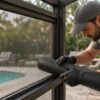
A little regular care goes a long way. Once a year, have someone look at:
- The overall frame, for bent or twisted members
- Doors, latches, locks and hinges
- Screws and fasteners, replacing any that are rusted or loose
- Wind bracing
- Gutters and drainage
- Any screen damage
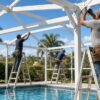
That is exactly the list covered by Gulf Gate’s maintenance plan, which is $199 per year. Between visits, rinse the frame and screens a few times a year and trim back branches that touch the roof. For bigger jobs such as rescrewing, repainting and rescreening, see screen maintenance and refurbishment.
When is it time to replace a pool cage instead of repairing it?
Repairs make sense when the frame is sound. Replacement is worth a look when you see:
- Bent, cracked or twisted beams
- Heavy corrosion at the base plates or connections
- A roof that sags
- The same repair coming back again and again
- A cage that was built well before current wind standards
A new cage needs a building permit and engineered plans. If you are weighing it up, read what happens during a pool cage replacement.
What can you check yourself this weekend?
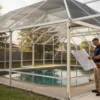
You do not need a ladder to spot trouble. Walk around the outside of the cage and look up at the roof line from the ground. Does any beam look bent, bowed or out of line with its neighbors? Do the screens look tight, or do some panels sag? Look at the base plates where the frame meets the deck and the slab, and note any rust streaks, flaking paint or white crusty buildup. Then open and close every door. A door that drags, sticks or no longer clicks shut by itself is worth fixing sooner rather than later.
Take photos as you go. A dated photo of a small problem makes it easy to tell, next year, whether it is getting worse. If anything looks structural, such as a bent beam or heavy corrosion at the base, do not climb on the cage. Call a professional to look at it.
FAQ
How long does a pool cage last in Florida?
The aluminum frame can last for decades with good care, while the screens usually need replacing every 8 to 15 years. Sun, salt air, storms and rusty fasteners are what shorten both.
How often should pool cage screens be replaced?
Most enclosures need new screens every 8 to 15 years. Replace them sooner if they are torn, loose, faded or brittle.
Can I just replace damaged screen panels?
Yes. Individual panels can be replaced. If many panels are failing from age, a full rescreen usually costs less over time.
Does a new pool cage need a permit?
Yes. A new screen enclosure needs a building permit and engineered plans that meet the Florida Building Code.
Get your pool cage checked
Gulf Gate Aluminum, at 4561 Samuel Street in Sarasota, serves homeowners in Sarasota, Bradenton, Venice, Lakewood Ranch, Siesta Key and Longboat Key. Call (941) 306-3448 (Mon–Fri, 8 a.m.–5 p.m.) or request a free estimate. See all our pool cages and screen enclosures.